Farm & Ranch Fence in Lufkin, TX
Farm and ranch fence around Lufkin covers a lot of ground: cattle pasture out in the county, hay fields, timber tracts, small horse and goat places, and acreage that just needs a solid perimeter. We build barbed wire, woven field fence and cross fencing, along with H-braces and ranch gates that hold their tension.
Rural fence is quoted differently from a backyard fence. Length, terrain, clearing and the animals you're holding all change the build.
Free farm & ranch fences quote
Takes about 30 seconds. Prefer to talk? (936) 299-5330
Please add your name and a phone number we can reach you at, then send again.
Ranch fencing in the Piney Woods
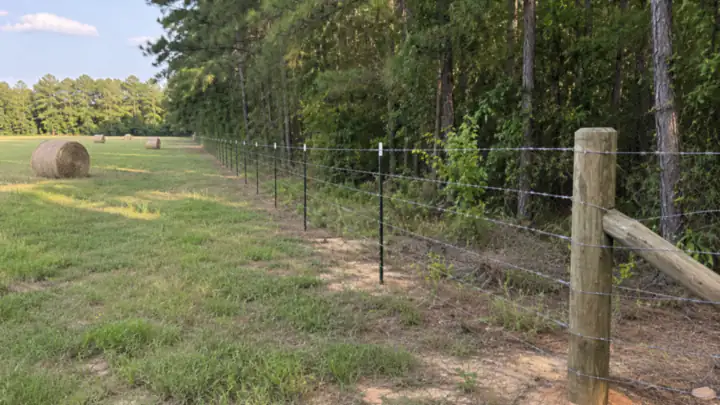
Deep East Texas pasture often borders timber, and that's where fence lines get tested. Trees and limbs fall on wire, brush grows into the fence, and wet bottoms along creeks stay soft for weeks. Clearing a strip along the line before building, then keeping it mowed, makes the fence easier to check and repair.
Braces carry a wire fence. Well-built H-braces at corners, ends and gates keep barbed wire and field fence tight, and they matter even more in soft ground. Line posts are usually steel T-posts with treated wood posts at intervals, and spacing depends on whether you're holding cattle, goats or horses, or just marking a boundary.
Farm and ranch fence options
Barbed wire
Four- or five-strand barbed wire on T-posts with wood braces, the standard cattle fence across East Texas.
Woven field fence
Woven wire for goats, sheep, hogs and dogs that would slip through barbed wire, often topped with a strand of barbed wire.
Horse fence
No-climb wire or board fence without barbs, built to be easy for horses to see.
Cross fencing
Interior fences that split pasture for rotational grazing or keep livestock apart.
Ranch gates
Tube steel and pipe gates hung on braced posts, sized for tractors and trailers.
What drives ranch fence cost
- Total length and the number of corners, braces and gates.
- Wire type: barbed wire costs less than woven field fence or no-climb horse wire.
- Clearing brush, small trees and old fence along the line.
- Terrain, including creek crossings, wet bottoms and slopes.
- Post choice: T-posts, treated wood posts or pipe.
Farm & Ranch Fence questions
How far apart should T-posts be on a cattle fence?
Common practice is roughly 10 to 15 feet between line posts on a barbed-wire cattle fence, closer in soft ground or where cattle lean on the fence. Woven wire often uses tighter spacing. Solid braces at corners and gates matter more than the exact spacing.
Can an old barbed wire fence that's falling down be replaced?
Yes. Old wire, rotten posts and grown-in brush can be removed and the line rebuilt, often along the same path. Sound braces or posts can sometimes stay, which lowers the cost.
More fence services
Farm & Ranch Fence in Lufkin: get your free quote
Tell us roughly how much fence you need and what it has to hold, and a local contractor will walk the property and quote it.